Fill in Your Indiana State 34401 Form
Similar forms
The Indiana State Form 34401 is similar to the OSHA Form 300, which is used for recording workplace injuries and illnesses. Both forms require detailed information about the incident, including the nature of the injury and the circumstances surrounding it. The OSHA Form 300 focuses on maintaining a record of work-related injuries and illnesses, while the Indiana State Form 34401 serves as a formal report for worker’s compensation claims. Each document aims to ensure that employers keep accurate records and comply with state and federal regulations regarding workplace safety.
Another document comparable to the Indiana State Form 34401 is the Workers' Compensation Claim Form. This form is utilized by employees to formally initiate a claim for benefits following a work-related injury. Like the Indiana State Form 34401, it collects information about the employee, the incident, and the resulting injury. Both documents require information about the employer, the claims administrator, and the circumstances of the injury, establishing a clear pathway for claims processing and ensuring that employees receive the benefits they are entitled to.
In addition to various workplace injury reports, understanding the nuances of trailer ownership documentation is also essential. A New York Trailer Bill of Sale serves as a critical legal record during the transfer of trailer ownership, protecting the rights of both the seller and the buyer. This form is especially important for transactions involving trailers, ensuring that all necessary information is accurately recorded for registration purposes. For further information and resources regarding this essential document, you can visit UsaLawDocs.com.
The Employee Injury Report serves a similar purpose as the Indiana State Form 34401. This report is often used internally by employers to document workplace injuries immediately after they occur. Both documents gather essential details such as the date of the incident, the nature of the injury, and witness information. While the Employee Injury Report may be used for internal tracking and immediate response, the Indiana State Form 34401 is designed for formal submission to regulatory bodies and for processing worker’s compensation claims.
Lastly, the First Report of Injury (FROI) form used in various states shares similarities with the Indiana State Form 34401. The FROI is a standardized document that initiates the workers' compensation claim process in many jurisdictions. Like the Indiana form, it requires comprehensive information about the injured employee, the incident details, and the employer’s information. Both forms serve to notify the appropriate authorities about the injury, ensuring that the claims process can begin promptly and efficiently.
FAQ
What is the Indiana State 34401 form used for?
The Indiana State 34401 form, also known as the First Report of Employee Injury or Illness, is primarily used to report workplace injuries or illnesses. Employers must complete this form to document incidents that lead to an employee's disability or time away from work. This information is crucial for the worker’s compensation process, ensuring that employees receive the benefits they are entitled to after an injury.
Who is responsible for filling out the Indiana State 34401 form?
The employer is responsible for completing the Indiana State 34401 form. It is typically filled out by a designated individual, such as a supervisor, human resources representative, or claims administrator. The form must be completed accurately to ensure proper reporting and processing of the claim.
What information is required on the form?
The form requires detailed information about the employee, the nature of the injury or illness, and the circumstances surrounding the incident. This includes the employee's name, social security number, job title, average weekly wage, details of the injury, and information about any witnesses. Additionally, it asks for specifics about the equipment or materials involved in the incident and the employee's status at the time of the accident.
How should dates be formatted on the form?
All dates on the Indiana State 34401 form should be entered in the MM/DD/YY format. This ensures consistency and clarity, making it easier for the reviewing authorities to process the information accurately.
What should I do if I don't have all the required information?
If you do not have all the necessary information to complete the Indiana State 34401 form, it is best to gather as much as you can and submit the form as soon as possible. You can indicate any missing information or mark it as "NA" (not applicable) where appropriate. It is important to provide as much detail as possible to avoid delays in processing the claim.
What happens if the form is not submitted on time?
Failure to submit the Indiana State 34401 form in a timely manner can lead to complications in the worker’s compensation process. Employers may face penalties, including a potential fine of $50 for not reporting an occupational injury or illness as required by Indiana law. Timely submission is crucial to ensure that employees receive their benefits without unnecessary delays.
How can I submit the completed form?
The completed Indiana State 34401 form should be returned electronically through an approved Electronic Data Interchange (EDI) process. This method ensures that the form is submitted securely and efficiently. If you have questions about the submission process, you can contact the appropriate state agency for guidance.
Where can I find assistance if I have questions about the form?
If you have any questions while filling out the Indiana State 34401 form, you can reach out to the Indiana Worker’s Compensation Board at (317) 232-3808. They can provide assistance and clarify any uncertainties you may have regarding the form or the reporting process.
Common mistakes
When filling out the Indiana State 34401 form, many individuals make common mistakes that can lead to delays or complications in processing their claims. One frequent error is leaving out important information. Every section of the form is designed to capture specific details about the incident, the employee, and the employer. Omitting even one piece of information can result in the form being returned or rejected. It’s crucial to review the form thoroughly to ensure all fields are completed accurately.
Another common mistake is failing to use the correct date format. The instructions specify that all dates should be entered in MM/DD/YY format. If someone accidentally uses a different format, it can cause confusion and may lead to processing issues. Double-checking the date format before submitting the form can save time and prevent unnecessary back-and-forth communication.
People often overlook the importance of providing a detailed description of how the injury or illness occurred. This section is vital for understanding the context of the claim. A vague description can lead to misunderstandings or disputes regarding the nature of the incident. Providing a clear, concise, and accurate account of the events can help facilitate a smoother claims process.
Additionally, many individuals forget to include the average weekly wage (AVG WG/WK) of the claimant. This figure is essential for determining compensation. Calculating the average wage involves totaling the last 52 weeks of earnings, including overtime and tips, and dividing by 52. Neglecting this step can significantly impact the claim's outcome.
Another mistake is not specifying the employee's status correctly. The form offers various options, and selecting the wrong status can lead to complications. For instance, if an employee is classified as part-time when they are actually full-time, it could affect the benefits they receive. Ensuring the correct status is marked is crucial for accurate processing.
Lastly, many people fail to provide the contact information for someone at the employer's premises who can offer additional information. This detail is important for claims administrators who may need to follow up for clarification. Without a designated contact, the claims process may be delayed as they attempt to gather necessary information.
Indiana State 34401 Preview
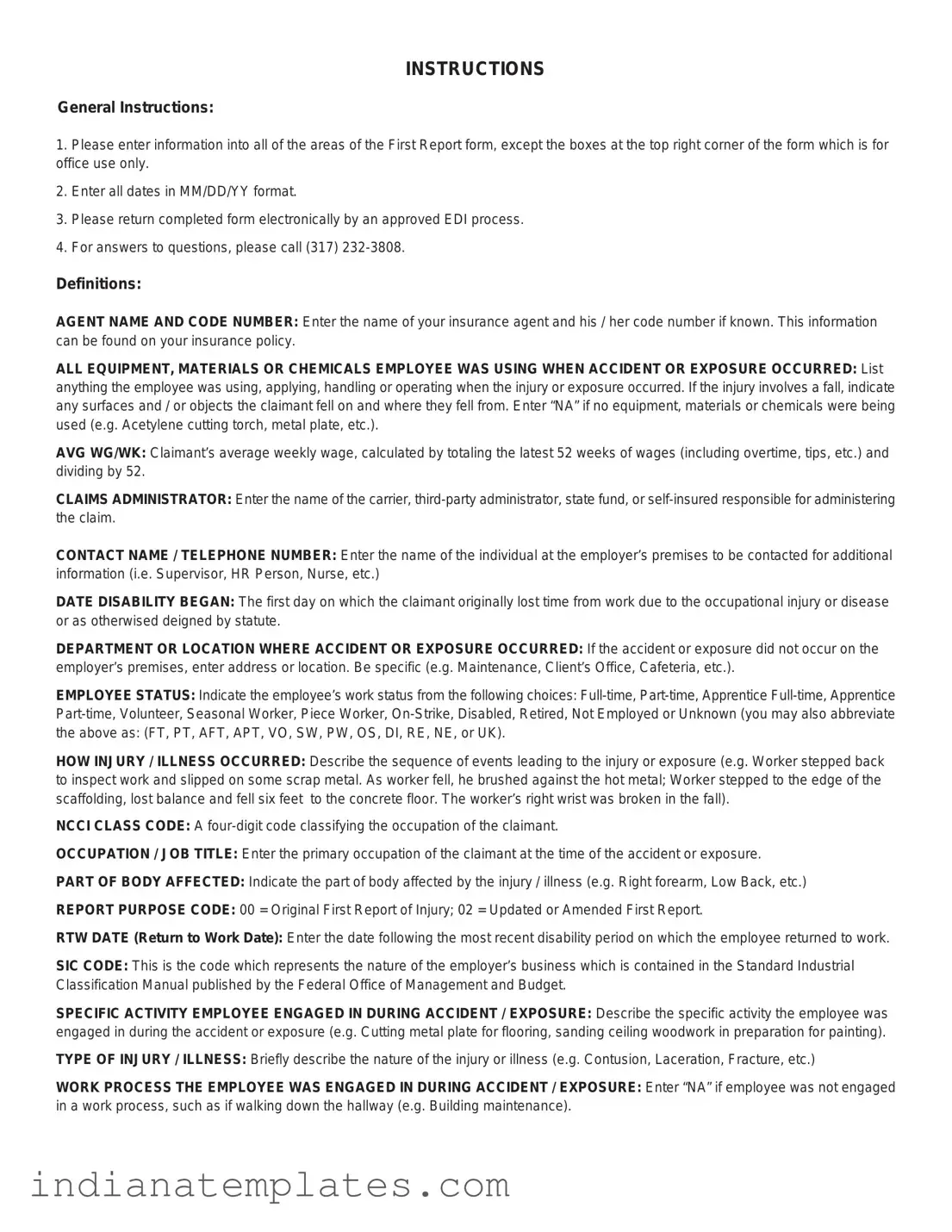
INSTRUCTIONS
General Instructions:
1.Please enter information into all of the areas of the First Report form, except the boxes at the top right corner of the form which is for office use only.
2.Enter all dates in MM/DD/YY format.
3.Please return completed form electronically by an approved EDI process.
4.For answers to questions, please call (317)
Definitions:
AGENT NAME AND CODE NUMBER: Enter the name of your insurance agent and his / her code number if known. This information can be found on your insurance policy.
ALL EQUIPMENT, MATERIALS OR CHEMICALS EMPLOYEE WAS USING WHEN ACCIDENT OR EXPOSURE OCCURRED: List anything the employee was using, applying, handling or operating when the injury or exposure occurred. If the injury involves a fall, indicate any surfaces and / or objects the claimant fell on and where they fell from. Enter “NA” if no equipment, materials or chemicals were being used (e.g. Acetylene cutting torch, metal plate, etc.).
AVG WG/WK: Claimant’s average weekly wage, calculated by totaling the latest 52 weeks of wages (including overtime, tips, etc.) and dividing by 52.
CLAIMS ADMINISTRATOR: Enter the name of the carrier,
CONTACT NAME / TELEPHONE NUMBER: Enter the name of the individual at the employer’s premises to be contacted for additional information (i.e. Supervisor, HR Person, Nurse, etc.)
DATE DISABILITY BEGAN: The first day on which the claimant originally lost time from work due to the occupational injury or disease or as otherwised deigned by statute.
DEPARTMENT OR LOCATION WHERE ACCIDENT OR EXPOSURE OCCURRED: If the accident or exposure did not occur on the employer’s premises, enter address or location. Be specific (e.g. Maintenance, Client’s Office, Cafeteria, etc.).
EMPLOYEE STATUS: Indicate the employee’s work status from the following choices:
HOW INJURY / ILLNESS OCCURRED: Describe the sequence of events leading to the injury or exposure (e.g. Worker stepped back to inspect work and slipped on some scrap metal. As worker fell, he brushed against the hot metal; Worker stepped to the edge of the scaffolding, lost balance and fell six feet to the concrete floor. The worker’s right wrist was broken in the fall).
NCCI CLASS CODE: A
OCCUPATION / JOB TITLE: Enter the primary occupation of the claimant at the time of the accident or exposure.
PART OF BODY AFFECTED: Indicate the part of body affected by the injury / illness (e.g. Right forearm, Low Back, etc.)
REPORT PURPOSE CODE: 00 = Original First Report of Injury; 02 = Updated or Amended First Report.
RTW DATE (Return to Work Date): Enter the date following the most recent disability period on which the employee returned to work.
SIC CODE: This is the code which represents the nature of the employer’s business which is contained in the Standard Industrial Classification Manual published by the Federal Office of Management and Budget.
SPECIFIC ACTIVITY EMPLOYEE ENGAGED IN DURING ACCIDENT / EXPOSURE: Describe the specific activity the employee was engaged in during the accident or exposure (e.g. Cutting metal plate for flooring, sanding ceiling woodwork in preparation for painting).
TYPE OF INJURY / ILLNESS: Briefly describe the nature of the injury or illness (e.g. Contusion, Laceration, Fracture, etc.)
WORK PROCESS THE EMPLOYEE WAS ENGAGED IN DURING ACCIDENT / EXPOSURE: Enter “NA” if employee was not engaged
in a work process, such as if walking down the hallway (e.g. Building maintenance).
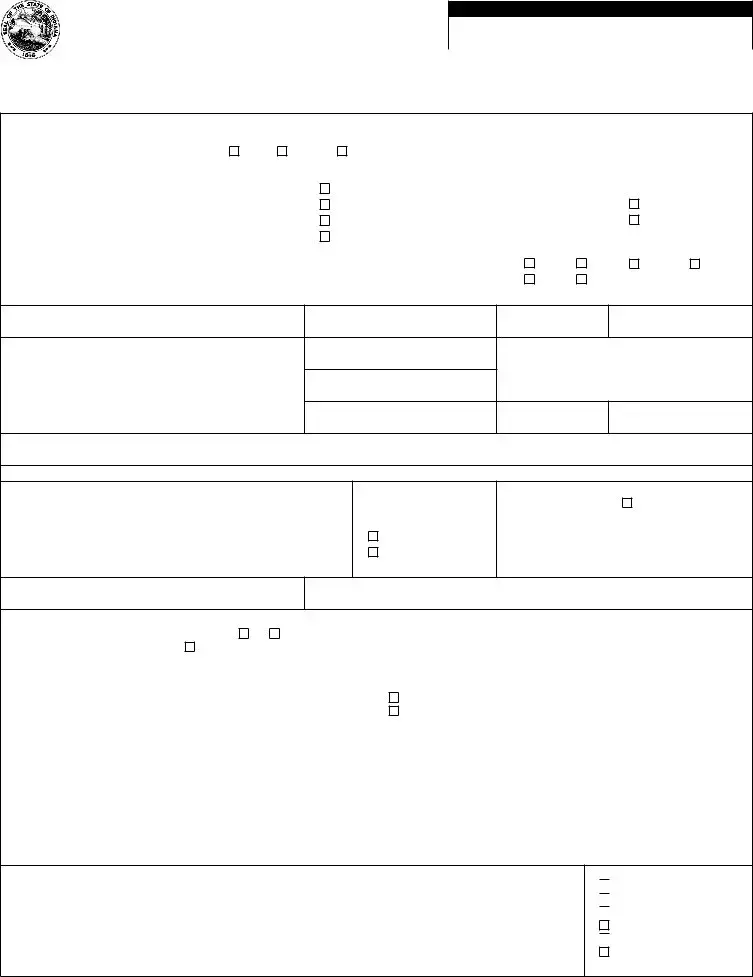
INDIANA WORKER’S COMPENSATION
FIRST REPORT OF EMPLOYEE INJURY, ILLNESS
State Form 34401 (R10 /
FOR WORKER’S COMPENSATION BOARD USE ONLY
Jurisdiction |
Jurisdiction claim number |
Process date |
|
|
|
Please return completed form electronically by an approved EDI process. |
PLEASE TYPE or PRINT IN INK |
NOTE: Your Social Security number is being requested by this state agency in order to pursue its statutory responsibilities. Disclosure is voluntary and you will not be penalized for refusal.
EMPLOYEE INFORMATION
Social Security number |
Date of birth |
|
Sex |
|
|
|
Occupation / Job title |
|
|
|
NCCI class code |
|
||
|
|
|
Male |
Female |
Unknown |
|
|
|
|
|
|
|
|
|
|
|
|
|
|
|
|
|
|
|
|
|
|
||
Name (last, first, middle) |
|
|
|
|
Marital status |
Date hired |
|
State of hire |
|
Employee status |
|
|||
|
|
|
|
|
|
Unmarried |
|
|
|
|
|
|
|
|
Address (number and street, city, state, ZIP code) |
|
|
|
Married |
Hrs / Day |
Days / Wk |
|
Avg Wg / Wk |
|
|
Paid Day of Injury |
|||
|
|
|
|
|
|
|
|
|
|
|
|
|||
|
|
|
|
|
|
Separated |
|
|
|
|
|
|
Salary Continued |
|
|
|
|
|
|
|
Unknown |
|
|
|
|
|
|
|
|
|
|
|
|
|
|
Wage |
Per |
|
|
|
|
|
|
|
|
|
|
|
|
|
|
|
|
|
|
|
|
||
|
|
|
|
|
|
|
Hour |
Day |
|
Month |
||||
Telephone number (include area |
|
|
Number of dependents |
$ |
|
|
Week |
|||||||
|
|
|
|
|
|
|
|
|
|
Year |
Other |
|
|
|
|
|
|
|
|
|
|
|
|
|
|
|
|
|
|
EMPLOYER INFORMATION
Name of employer
Employer ID#
SIC code
Insured report number
Address of employer (number and street, city, state, ZIP code)
Location number
Employer’s location address (if different)
Telephone number
Carrier / Administrator claim number
OSHA log number
Report purpose code
Actual location of accident / exposure (if not on employer’s premises)
CARRIER / CLAIMS ADMINISTRATOR INFORMATION
Name of claims administrator |
Carrier federal ID number |
Check if appropriate |
|
|
|
Self Insurance |
Address of claims administrator (number and street, city, state, ZIP code) |
|
Policy / |
|
|
Insurance Carrier |
|
|
Telephone number |
Third Party Admin. |
Policy period |
|
|
|
From |
To |
Name of agent
Code number
OCCURRENCE / TREATMENT INFORMATION
Date of Inj./ Exp. |
Time of occurrence |
AM PM |
Date employer notified |
|
Type of injury / exposure |
|
Type code |
||
|
Cannot be determined |
|
|
|
|
|
|
||
|
|
|
|
|
|
|
|
|
|
Last work date |
Time workday began |
|
Date disability began |
|
Part of body |
|
Part code |
||
|
|
|
|
|
|
|
|
|
|
RTW date |
Date of death |
|
Injury / Exposure occurred |
Yes |
Name of contact |
Telephone number |
|||
|
|
|
on employer’s premises? |
No |
|
|
|
||
|
|
|
|
|
|
|
|
|
|
Department or location where accident / exposure occurred |
|
|
|
|
All equipment, materials, or chemicals involved in accident |
||||
|
|
|
|
|
|
|
|
||
Specific activity engaged in during accident / exposure |
|
|
|
|
Work process employee engaged in during accident / exposure |
||||
|
|
|
|
|
|
||||
How injury / exposure occurred. Describe the sequence of events and include any relevant objects or substances. |
|
|
|||||||
|
|
|
|
|
|
|
|
|
|
|
|
|
|
|
|
|
|
Cause of injury code |
|
|
|
|
|
|
|
|
|
|
|
Name of physician / health care provider
Hospital or offsite treatment (name and address)
Name of witness |
|
Telephone number |
Date administrator notified |
||
|
|
|
|
|
|
Date prepared |
Name of preparer |
|
Title |
|
Telephone number |
|
|
|
|
|
|
INITIAL TREATMENT

 No Medical Treatment

 Minor: By Employer

 Minor: Clinic / Hospital
Emergency Care

 Hospitalized > 24 Hours
Future Major Medical / Lost
Time Anticipated
An employer’s failure to report an occupational injury or illness may result in a $50 fine (IC
Different PDF Forms
Indiana State 50181 - This form is filed in the Indiana UCC Financing Statement system.
To prepare for unforeseen circumstances, it is crucial to understand the importance of a thoughtful Durable Power of Attorney arrangement. Implementing this legal document allows you to choose a trusted individual to manage your affairs. Explore our guidelines on Durable Power of Attorney utilization to ensure your wishes are respected even in times of incapacity.
Indiana Otp 901 - Updates to the form may occur; check the Indiana Department of Revenue website.